产品定价 立即试用
云平台
欧洲地区
文档 > 其他功能 > 设备配置
入门
指南 API 常见问题
目录

设备配置

使用场景

作为设备制造商或固件开发者,我希望设备能在ThingsBoard中自动完成配置。 在自动配置过程中,设备可以自行生成唯一凭证,也可以请求服务器为其生成唯一凭证。

自3.5版本起,ThingsBoard支持通过X.509证书链在MQTT上进行认证以完成新设备的自动配置。

工作原理

设备可以向ThingsBoard发送设备配置请求(Request)。请求必须包含Provision key和secret。 请求可选择性包含设备名称及设备生成的凭证。 若未提供凭证,服务器将为设备生成AccessToken。

配置请求示例:

1
2
3
4
5
{
  "deviceName": "DEVICE_NAME",
  "provisionDeviceKey": "YOUR_PROVISION_KEY_HERE",
  "provisionDeviceSecret": "YOUR_PROVISION_SECRET_HERE"
}

ThingsBoard会验证请求并返回设备配置响应(Response)。 成功响应包含设备ID、凭证类型和正文。 若验证失败,响应仅包含状态。

配置响应示例:

1
2
3
4
5
{
  "provisionDeviceStatus":"SUCCESS",
  "credentialsType":"ACCESS_TOKEN",
  "accessToken":"sLzc0gDAZPkGMzFVTyUY"
}

验证请求时,ThingsBoard会先根据provisionDeviceKeyprovisionDeviceSecret查找对应的设备配置。 找到配置文件后,平台会根据已配置的provision策略验证设备名称。 支持两种provision策略:

  • 允许创建新设备 - 检查同名设备是否尚未在ThingsBoard中注册。 适用于生产时无法预知唯一设备名称列表(如MAC地址)且设备固件中可访问该信息的场景。 实现更简单,但安全性低于第二种策略。
  • 检查预配置设备 - 检查同名设备是否已在ThingsBoard中创建但尚未完成provision。 适用于仅允许特定设备列表进行provision的场景。例如在生产中已收集唯一ID(如MAC地址)列表。 可使用批量配置将该列表导入ThingsBoard。之后,列表中的设备可发起provision请求,其他设备无法完成配置。

配置完成后,ThingsBoard将更新设备的provisionState服务端属性,并将其设为provisioned

设备配置配置

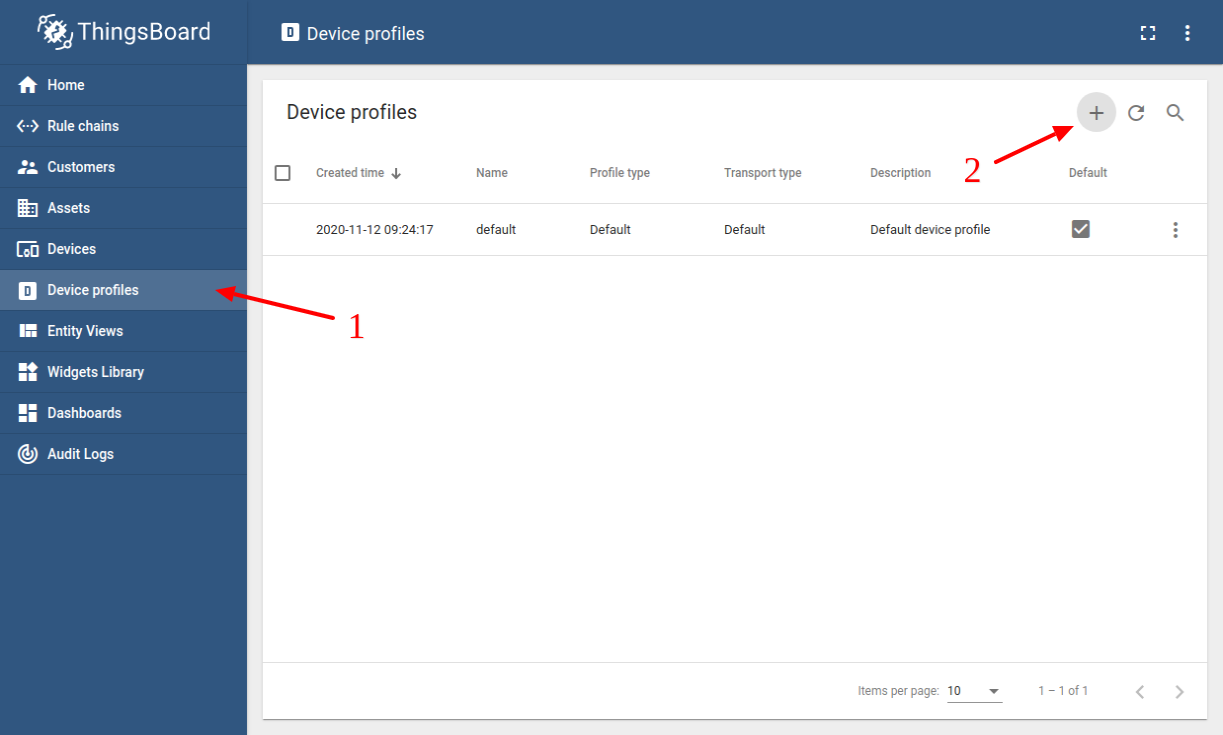
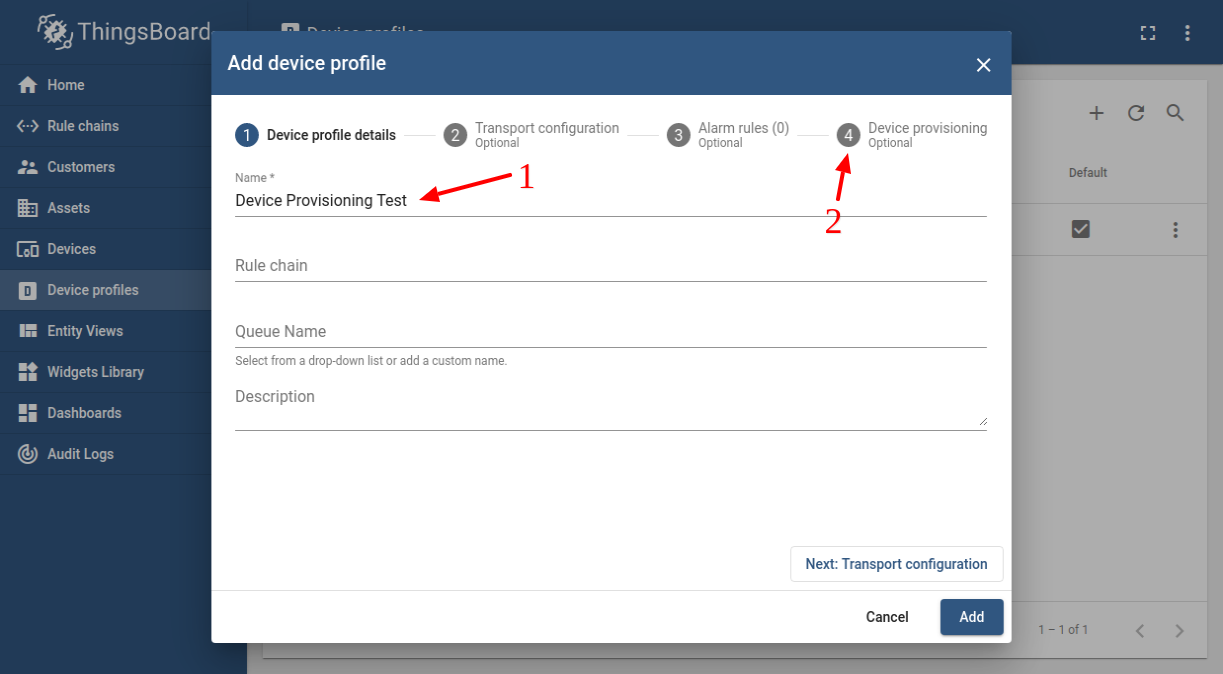
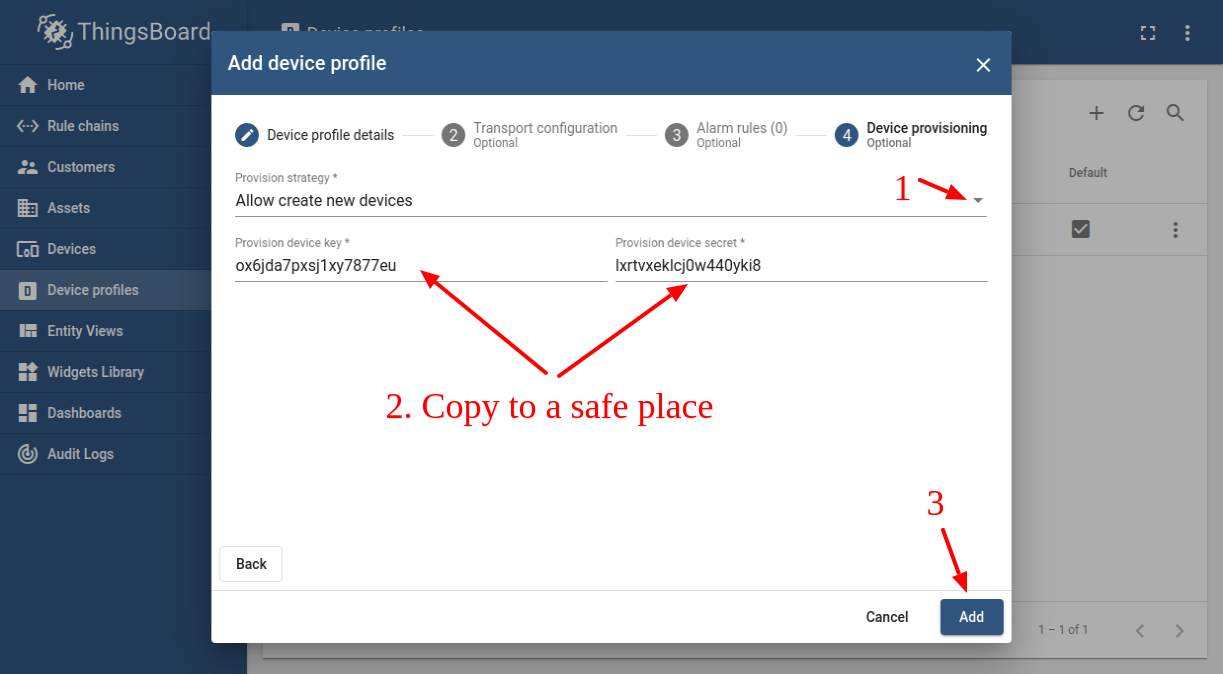
需在设备配置中启用provisioning功能,并获取provision device key和provision device secret。

  • You can either create a new device profile or open the existing one. To create a new one you should open the Device profiles page and click on the "+" icon in the table header.
  • Input a name of the new device profile and click on Step 4 of the "Add device profile" wizard. We will use name "Device Provisioning Test" in this example. However, typically this should be your device model or similar.
  • Choose one of the provisioning strategies, copy the provisioning key and secret, and finally click "Add".

Provision设备API

MQTT设备API

可使用MQTTAPI参考开发执行provision请求的设备固件。 如前所述,设备可请求服务器生成凭证,或在注册时提供自身凭证。 各选项的请求/响应及代码示例见下:

参数 示例值 说明
deviceName DEVICE_NAME ThingsBoard 中的设备名称。
provisionDeviceKey PUT_PROVISION_KEY_HERE 设备 profile 中配置的 provisioning device key。
provisionDeviceSecret PUT_PROVISION_SECRET_HERE 设备 profile 中配置的 provisioning device secret。

Provisioning 请求数据示例:

1
2
3
4
5
{
  "deviceName": "DEVICE_NAME",
  "provisionDeviceKey": "PUT_PROVISION_KEY_HERE",
  "provisionDeviceSecret": "PUT_PROVISION_SECRET_HERE"
}

Provisioning 响应示例:

1
2
3
4
5
{
  "status":"SUCCESS",
  "credentialsType":"ACCESS_TOKEN",
  "credentialsValue":"sLzc0gDAZPkGMzFVTyUY"
}

示例脚本

与 ThingsBoard 通信需使用 Paho MQTT 模块,请先安装:

1
pip3 install paho-mqtt --user

脚本源码如下,可复制到文件(例如 device-provision-example.py)中:

1
device-provision-example.py

运行脚本并按提示操作。使用 Python 3 启动:

1
python3 device-provision-example.py

脚本源码:

1
2
3
4
5
6
7
8
9
10
11
12
13
14
15
16
17
18
19
20
21
22
23
24
25
26
27
28
29
30
31
32
33
34
35
36
37
38
39
40
41
42
43
44
45
46
47
48
49
50
51
52
53
54
55
56
57
58
59
60
61
62
63
64
65
66
67
68
69
70
71
72
73
74
75
76
77
78
79
80
81
82
83
84
85
86
87
88
89
90
91
92
93
94
95
96
97
98
99
100
101
102
103
104
105
106
107
108
109
110
111
112
113
114
115
116
117
118
119
120
121
122
123
124
125
126
127
128
129
130
131
132
from paho.mqtt.client import Client
from json import dumps, loads

RESULT_CODES = {
    1: "incorrect protocol version",
    2: "invalid client identifier",
    3: "server unavailable",
    4: "bad username or password",
    5: "not authorised",
    }


def collect_required_data():
    config = {}
    print("\n\n", "="*80, sep="")
    print(" "*10, "\033[1m\033[94mThingsBoard device provisioning with basic authorization example script.\033[0m", sep="")
    print("="*80, "\n\n", sep="")
    host = input("Please write your ThingsBoard \033[93mhost\033[0m or leave it blank to use default (mqtt.eu.thingsboard.cloud): ")
    config["host"] = host if host else "mqtt.eu.thingsboard.cloud"
    port = input("Please write your ThingsBoard \033[93mport\033[0m or leave it blank to use default (1883): ")
    config["port"] = int(port) if port else 1883
    config["provision_device_key"] = input("Please write \033[93mprovision device key\033[0m: ")
    config["provision_device_secret"] = input("Please write \033[93mprovision device secret\033[0m: ")
    device_name = input("Please write \033[93mdevice name\033[0m or leave it blank to generate: ")
    if device_name:
        config["device_name"] = device_name
    print("\n", "="*80, "\n", sep="")
    return config


class ProvisionClient(Client):
    PROVISION_REQUEST_TOPIC = "/provision/request"
    PROVISION_RESPONSE_TOPIC = "/provision/response"

    def __init__(self, host, port, provision_request):
        super().__init__()
        self._host = host
        self._port = port
        self._username = "provision"
        self.on_connect = self.__on_connect
        self.on_message = self.__on_message
        self.__provision_request = provision_request

    def __on_connect(self, client, userdata, flags, rc):  # Callback for connect
        if rc == 0:
            print("[Provisioning client] Connected to ThingsBoard ")
            client.subscribe(self.PROVISION_RESPONSE_TOPIC)  # Subscribe to provisioning response topic
            provision_request = dumps(self.__provision_request)
            print("[Provisioning client] Sending provisioning request %s" % provision_request)
            client.publish(self.PROVISION_REQUEST_TOPIC, provision_request)  # Publishing provisioning request topic
        else:
            print("[Provisioning client] Cannot connect to ThingsBoard!, result: %s" % RESULT_CODES[rc])

    def __on_message(self, client, userdata, msg):
        decoded_payload = msg.payload.decode("UTF-8")
        print("[Provisioning client] Received data from ThingsBoard: %s" % decoded_payload)
        decoded_message = loads(decoded_payload)
        provision_device_status = decoded_message.get("status")
        if provision_device_status == "SUCCESS":
            self.__save_credentials(decoded_message["credentialsValue"])
        else:
            print("[Provisioning client] Provisioning was unsuccessful with status %s and message: %s" % (provision_device_status, decoded_message["errorMsg"]))
        self.disconnect()

    def provision(self):
        print("[Provisioning client] Connecting to ThingsBoard (provisioning client)")
        self.__clean_credentials()
        self.connect(self._host, self._port, 60)
        self.loop_forever()

    def get_new_client(self):
        client_credentials = self.__get_credentials()
        new_client = None
        if client_credentials:
            new_client = Client()
            new_client.username_pw_set(client_credentials)
            print("[Provisioning client] Read credentials from file.")
        else:
            print("[Provisioning client] Cannot read credentials from file!")
        return new_client

    @staticmethod
    def __get_credentials():
        new_credentials = None
        try:
            with open("credentials", "r") as credentials_file:
                new_credentials = credentials_file.read()
        except Exception as e:
            print(e)
        return new_credentials

    @staticmethod
    def __save_credentials(credentials):
        with open("credentials", "w") as credentials_file:
            credentials_file.write(credentials)

    @staticmethod
    def __clean_credentials():
        open("credentials", "w").close()


def on_tb_connected(client, userdata, flags, rc):  # Callback for connect with received credentials
    if rc == 0:
        print("[ThingsBoard client] Connected to ThingsBoard with credentials: %s" % client._username.decode())
    else:
        print("[ThingsBoard client] Cannot connect to ThingsBoard!, result: %s" % RESULT_CODES[rc])


if __name__ == '__main__':

    config = collect_required_data()

    THINGSBOARD_HOST = config["host"]  # ThingsBoard instance host
    THINGSBOARD_PORT = config["port"]  # ThingsBoard instance MQTT port

    PROVISION_REQUEST = {"provisionDeviceKey": config["provision_device_key"],  # Provision device key, replace this value with your value from device profile.
                         "provisionDeviceSecret": config["provision_device_secret"],  # Provision device secret, replace this value with your value from device profile.
                         }
    if config.get("device_name") is not None:
        PROVISION_REQUEST["deviceName"] = config["device_name"]
    provision_client = ProvisionClient(THINGSBOARD_HOST, THINGSBOARD_PORT, PROVISION_REQUEST)
    provision_client.provision()  # Request provisioned data
    tb_client = provision_client.get_new_client()  # Getting client with provisioned data
    if tb_client:
        tb_client.on_connect = on_tb_connected  # Setting callback for connect
        tb_client.connect(THINGSBOARD_HOST, THINGSBOARD_PORT, 60)
        tb_client.loop_forever()  # Starting infinity loop
    else:
        print("Client was not created!")

参数 示例值 说明
deviceName DEVICE_NAME ThingsBoard 中的设备名称。
provisionDeviceKey PUT_PROVISION_KEY_HERE 设备 profile 中配置的 provisioning device key。
provisionDeviceSecret PUT_PROVISION_SECRET_HERE 设备 profile 中配置的 provisioning device secret。
credentialsType ACCESS_TOKEN Credentials type 参数。
token DEVICE_ACCESS_TOKEN ThingsBoard 中的设备 access token。

Provisioning 请求数据示例:

1
2
3
4
5
6
7
{
  "deviceName": "DEVICE_NAME",
  "provisionDeviceKey": "PUT_PROVISION_KEY_HERE",
  "provisionDeviceSecret": "PUT_PROVISION_SECRET_HERE",
  "credentialsType": "ACCESS_TOKEN",
  "token": "DEVICE_ACCESS_TOKEN"
}

Provisioning 响应示例:

1
2
3
4
5
{
  "credentialsType":"ACCESS_TOKEN",
  "credentialsValue":"DEVICE_ACCESS_TOKEN",
  "status":"SUCCESS"
}

示例脚本

与 ThingsBoard 通信需使用 Paho MQTT 模块,请先安装:

1
pip3 install paho-mqtt --user

脚本源码如下,可复制到文件(例如 device-provision-example.py)中:

1
device-provision-example.py

运行脚本并按提示操作。使用 Python 3 启动:

1
python3 device-provision-example.py

脚本源码:

1
2
3
4
5
6
7
8
9
10
11
12
13
14
15
16
17
18
19
20
21
22
23
24
25
26
27
28
29
30
31
32
33
34
35
36
37
38
39
40
41
42
43
44
45
46
47
48
49
50
51
52
53
54
55
56
57
58
59
60
61
62
63
64
65
66
67
68
69
70
71
72
73
74
75
76
77
78
79
80
81
82
83
84
85
86
87
88
89
90
91
92
93
94
95
96
97
98
99
100
101
102
103
104
105
106
107
108
109
110
111
112
113
114
115
116
117
118
119
120
121
122
123
124
125
126
127
128
129
130
131
132
133
134
135
from paho.mqtt.client import Client
from json import dumps, loads

RESULT_CODES = {
    1: "incorrect protocol version",
    2: "invalid client identifier",
    3: "server unavailable",
    4: "bad username or password",
    5: "not authorised",
    }


def collect_required_data():
    config = {}
    print("\n\n", "="*80, sep="")
    print(" "*10, "\033[1m\033[94mThingsBoard device provisioning with access token authorization example script. MQTT API\033[0m", sep="")
    print("="*80, "\n\n", sep="")
    host = input("Please write your ThingsBoard \033[93mhost\033[0m or leave it blank to use default (mqtt.eu.thingsboard.cloud): ")
    config["host"] = host if host else "mqtt.eu.thingsboard.cloud"
    port = input("Please write your ThingsBoard \033[93mport\033[0m or leave it blank to use default (1883): ")
    config["port"] = int(port) if port else 1883
    config["provision_device_key"] = input("Please write \033[93mprovision device key\033[0m: ")
    config["provision_device_secret"] = input("Please write \033[93mprovision device secret\033[0m: ")
    config["token"] = input("Please write \033[93mdevice access token\033[0m: ")
    device_name = input("Please write \033[93mdevice name\033[0m or leave it blank to generate: ")
    if device_name:
        config["device_name"] = device_name
    print("\n", "="*80, "\n", sep="")
    return config


class ProvisionClient(Client):
    PROVISION_REQUEST_TOPIC = "/provision/request"
    PROVISION_RESPONSE_TOPIC = "/provision/response"

    def __init__(self, host, port, provision_request):
        super().__init__()
        self._host = host
        self._port = port
        self._username = "provision"
        self.on_connect = self.__on_connect
        self.on_message = self.__on_message
        self.__provision_request = provision_request

    def __on_connect(self, client, userdata, flags, rc):  # Callback for connect
        if rc == 0:
            print("[Provisioning client] Connected to ThingsBoard ")
            client.subscribe(self.PROVISION_RESPONSE_TOPIC)  # Subscribe to provisioning response topic
            provision_request = dumps(self.__provision_request)
            print("[Provisioning client] Sending provisioning request %s" % provision_request)
            client.publish(self.PROVISION_REQUEST_TOPIC, provision_request)  # Publishing provisioning request topic
        else:
            print("[Provisioning client] Cannot connect to ThingsBoard!, result: %s" % RESULT_CODES[rc])

    def __on_message(self, client, userdata, msg):
        decoded_payload = msg.payload.decode("UTF-8")
        print("[Provisioning client] Received data from ThingsBoard: %s" % decoded_payload)
        decoded_message = loads(decoded_payload)
        provision_device_status = decoded_message.get("status")
        if provision_device_status == "SUCCESS":
            self.__save_credentials(decoded_message["credentialsValue"])
        else:
            print("[Provisioning client] Provisioning was unsuccessful with status %s and message: %s" % (provision_device_status, decoded_message["errorMsg"]))
        self.disconnect()

    def provision(self):
        print("[Provisioning client] Connecting to ThingsBoard (provisioning client)")
        self.__clean_credentials()
        self.connect(self._host, self._port, 60)
        self.loop_forever()

    def get_new_client(self):
        client_credentials = self.__get_credentials()
        new_client = None
        if client_credentials:
            new_client = Client()
            new_client.username_pw_set(client_credentials)
            print("[Provisioning client] Read credentials from file.")
        else:
            print("[Provisioning client] Cannot read credentials from file!")
        return new_client

    @staticmethod
    def __get_credentials():
        new_credentials = None
        try:
            with open("credentials", "r") as credentials_file:
                new_credentials = credentials_file.read()
        except Exception as e:
            print(e)
        return new_credentials

    @staticmethod
    def __save_credentials(credentials):
        with open("credentials", "w") as credentials_file:
            credentials_file.write(credentials)

    @staticmethod
    def __clean_credentials():
        open("credentials", "w").close()


def on_tb_connected(client, userdata, flags, rc):  # Callback for connect with received credentials
    if rc == 0:
        print("[ThingsBoard client] Connected to ThingsBoard with credentials: %s" % client._username.decode())
    else:
        print("[ThingsBoard client] Cannot connect to ThingsBoard!, result: %s" % RESULT_CODES[rc])


if __name__ == '__main__':

    config = collect_required_data()

    THINGSBOARD_HOST = config["host"]  # ThingsBoard instance host
    THINGSBOARD_PORT = config["port"]  # ThingsBoard instance MQTT port

    PROVISION_REQUEST = {"provisionDeviceKey": config["provision_device_key"],  # Provision device key, replace this value with your value from device profile.
                         "provisionDeviceSecret": config["provision_device_secret"],  # Provision device secret, replace this value with your value from device profile.
                         "credentialsType": "ACCESS_TOKEN",
                         "token": config["token"],
                         }
    if config.get("device_name") is not None:
        PROVISION_REQUEST["deviceName"] = config["device_name"]
    provision_client = ProvisionClient(THINGSBOARD_HOST, THINGSBOARD_PORT, PROVISION_REQUEST)
    provision_client.provision()  # Request provisioned data
    tb_client = provision_client.get_new_client()  # Getting client with provisioned data
    if tb_client:
        tb_client.on_connect = on_tb_connected  # Setting callback for connect
        tb_client.connect(THINGSBOARD_HOST, THINGSBOARD_PORT, 60)
        tb_client.loop_forever()  # Starting infinity loop
    else:
        print("Client was not created!")

参数 示例值 说明
deviceName DEVICE_NAME ThingsBoard 中的设备名称。
provisionDeviceKey PUT_PROVISION_KEY_HERE 设备 profile 中配置的 provisioning device key。
provisionDeviceSecret PUT_PROVISION_SECRET_HERE 设备 profile 中配置的 provisioning device secret。
credentialsType MQTT_BASIC Credentials type 参数。
username DEVICE_USERNAME_HERE ThingsBoard 中的设备 username。
password DEVICE_PASSWORD_HERE ThingsBoard 中的设备 password。
clientId DEVICE_CLIENT_ID_HERE ThingsBoard 中的设备 client id。

Provisioning 请求数据示例:

1
2
3
4
5
6
7
8
9
{
  "deviceName": "DEVICE_NAME",
  "provisionDeviceKey": "PUT_PROVISION_KEY_HERE",
  "provisionDeviceSecret": "PUT_PROVISION_SECRET_HERE",
  "credentialsType": "MQTT_BASIC",
  "username": "DEVICE_USERNAME_HERE",
  "password": "DEVICE_PASSWORD_HERE",
  "clientId": "DEVICE_CLIENT_ID_HERE"
}

Provisioning 响应示例:

1
2
3
4
5
6
7
8
9
{
  "credentialsType":"MQTT_BASIC",
  "credentialsValue": {
    "clientId":"DEVICE_CLIENT_ID_HERE",
    "userName":"DEVICE_USERNAME_HERE",
    "password":"DEVICE_PASSWORD_HERE"
    },
  "status":"SUCCESS"
}

示例脚本

与 ThingsBoard 通信需使用 Paho MQTT 模块,请先安装:

1
pip3 install paho-mqtt --user

脚本源码如下,可复制到文件(例如 device-provision-example.py)中:

1
device-provision-example.py

运行脚本并按提示操作。使用 Python 3 启动:

1
python3 device-provision-example.py

脚本源码:

1
2
3
4
5
6
7
8
9
10
11
12
13
14
15
16
17
18
19
20
21
22
23
24
25
26
27
28
29
30
31
32
33
34
35
36
37
38
39
40
41
42
43
44
45
46
47
48
49
50
51
52
53
54
55
56
57
58
59
60
61
62
63
64
65
66
67
68
69
70
71
72
73
74
75
76
77
78
79
80
81
82
83
84
85
86
87
88
89
90
91
92
93
94
95
96
97
98
99
100
101
102
103
104
105
106
107
108
109
110
111
112
113
114
115
116
117
118
119
120
121
122
123
124
125
126
127
128
129
130
131
132
133
134
135
136
137
138
139
from paho.mqtt.client import Client
from json import dumps, loads

RESULT_CODES = {
    1: "incorrect protocol version",
    2: "invalid client identifier",
    3: "server unavailable",
    4: "bad username or password",
    5: "not authorised",
    }


def collect_required_data():
    config = {}
    print("\n\n", "="*80, sep="")
    print(" "*10, "\033[1m\033[94mThingsBoard device provisioning with basic authorization example script.\033[0m", sep="")
    print("="*80, "\n\n", sep="")
    host = input("Please write your ThingsBoard \033[93mhost\033[0m or leave it blank to use default (mqtt.eu.thingsboard.cloud): ")
    config["host"] = host if host else "mqtt.eu.thingsboard.cloud"
    port = input("Please write your ThingsBoard \033[93mport\033[0m or leave it blank to use default (1883): ")
    config["port"] = int(port) if port else 1883
    config["provision_device_key"] = input("Please write \033[93mprovision device key\033[0m: ")
    config["provision_device_secret"] = input("Please write \033[93mprovision device secret\033[0m: ")
    device_name = input("Please write \033[93mdevice name\033[0m or leave it blank to generate: ")
    if device_name:
        config["device_name"] = device_name
    config["clientId"] = input("Please write \033[93mclient Id\033[0m: ")
    config["username"] = input("Please write \033[93musername\033[0m: ")
    config["password"] = input("Please write \033[93mpassword\033[0m: ")
    print("\n", "="*80, "\n", sep="")
    return config


class ProvisionClient(Client):
    PROVISION_REQUEST_TOPIC = "/provision/request"
    PROVISION_RESPONSE_TOPIC = "/provision/response"

    def __init__(self, host, port, provision_request):
        super().__init__()
        self._host = host
        self._port = port
        self._username = "provision"
        self.on_connect = self.__on_connect
        self.on_message = self.__on_message
        self.__provision_request = provision_request

    def __on_connect(self, client, userdata, flags, rc):  # Callback for connect
        if rc == 0:
            print("[Provisioning client] Connected to ThingsBoard ")
            client.subscribe(self.PROVISION_RESPONSE_TOPIC)  # Subscribe to provisioning response topic
            provision_request = dumps(self.__provision_request)
            print("[Provisioning client] Sending provisioning request %s" % provision_request)
            client.publish(self.PROVISION_REQUEST_TOPIC, provision_request)  # Publishing provisioning request topic
        else:
            print("[Provisioning client] Cannot connect to ThingsBoard!, result: %s" % RESULT_CODES[rc])

    def __on_message(self, client, userdata, msg):
        decoded_payload = msg.payload.decode("UTF-8")
        print("[Provisioning client] Received data from ThingsBoard: %s" % decoded_payload)
        decoded_message = loads(decoded_payload)
        provision_device_status = decoded_message.get("status")
        if provision_device_status == "SUCCESS":
            self.__save_credentials(decoded_message["credentialsValue"])
        else:
            print("[Provisioning client] Provisioning was unsuccessful with status %s and message: %s" % (provision_device_status, decoded_message["errorMsg"]))
        self.disconnect()

    def provision(self):
        print("[Provisioning client] Connecting to ThingsBoard (provisioning client)")
        self.__clean_credentials()
        self.connect(self._host, self._port, 60)
        self.loop_forever()

    def get_new_client(self):
        client_credentials = loads(self.__get_credentials())
        new_client = None
        if client_credentials:
            new_client = Client(client_id=client_credentials["clientId"])  # Setting client id
            new_client.username_pw_set(client_credentials["userName"], client_credentials["password"])  # Setting username and password for ThingsBoard client
            print("[Provisioning client] Read credentials from file.")
        else:
            print("[Provisioning client] Cannot read credentials from file!")
        return new_client

    @staticmethod
    def __get_credentials():
        new_credentials = None
        try:
            with open("credentials", "r") as credentials_file:
                new_credentials = credentials_file.read()
        except Exception as e:
            print(e)
        return new_credentials

    @staticmethod
    def __save_credentials(credentials):
        with open("credentials", "w") as credentials_file:
            credentials_file.write(dumps(credentials))

    @staticmethod
    def __clean_credentials():
        open("credentials", "w").close()


def on_tb_connected(client, userdata, flags, rc):  # Callback for connect with received credentials
    if rc == 0:
        print("[ThingsBoard client] Connected to ThingsBoard with credentials: username: %s, password: %s, client id: %s" % (client._username.decode(), client._password.decode(), client._client_id.decode()))
    else:
        print("[ThingsBoard client] Cannot connect to ThingsBoard!, result: %s" % RESULT_CODES[rc])


if __name__ == '__main__':
    config = collect_required_data()

    THINGSBOARD_HOST = config["host"]  # ThingsBoard instance host
    THINGSBOARD_PORT = config["port"]  # ThingsBoard instance MQTT port

    PROVISION_REQUEST = {"provisionDeviceKey": config["provision_device_key"],
                         # Provision device key, replace this value with your value from device profile.
                         "provisionDeviceSecret": config["provision_device_secret"],
                         # Provision device secret, replace this value with your value from device profile.
                         "credentialsType": "MQTT_BASIC",
                         "username": config["username"],
                         "password": config["password"],
                         "clientId": config["clientId"],
                         }
    if config.get("device_name") is not None:
        PROVISION_REQUEST["deviceName"] = config["device_name"]
    provision_client = ProvisionClient(THINGSBOARD_HOST, THINGSBOARD_PORT, PROVISION_REQUEST)
    provision_client.provision()  # Request provisioned data
    tb_client = provision_client.get_new_client()  # Getting client with provisioned data
    if tb_client:
        tb_client.on_connect = on_tb_connected  # Setting callback for connect
        tb_client.connect(THINGSBOARD_HOST, THINGSBOARD_PORT, 60)
        tb_client.loop_forever()  # Starting infinity loop
    else:
        print("Client was not created!")
文档信息图标


说明:使用本功能前,需先在ThingsBoard 中配置 MQTT over SSL

参数 示例值 说明
deviceName DEVICE_NAME ThingsBoard 中的设备名称。
provisionDeviceKey PUT_PROVISION_KEY_HERE 设备 profile 中配置的 provisioning device key。
provisionDeviceSecret PUT_PROVISION_SECRET_HERE 设备 profile 中配置的 provisioning device secret。
credentialsType X509_CERTIFICATE Credentials type 参数。
hash MIIB……..AQAB 设备在ThingsBoard 中的 X509 公钥 hash。

Provisioning 请求数据示例:

1
2
3
4
5
6
7
{
  "deviceName": "DEVICE_NAME",
  "provisionDeviceKey": "PUT_PROVISION_KEY_HERE",
  "provisionDeviceSecret": "PUT_PROVISION_SECRET_HERE",
  "credentialsType": "X509_CERTIFICATE",
  "hash": "MIIB........AQAB"
}

Provisioning 响应示例:

1
2
3
4
5
6
7
{
  "deviceId":"3b829220-232f-11eb-9d5c-e9ed3235dff8",
  "credentialsType":"X509_CERTIFICATE",
  "credentialsId":"f307a1f717a12b32c27203cf77728d305d29f64694a8311be921070dd1259b3a",
  "credentialsValue":"MIIB........AQAB",
  "provisionDeviceStatus":"SUCCESS"
}

MQTT 示例脚本

mqttserver.pub.pem(服务器公钥)置于脚本所在目录。

1
2
3
4
5
6
7
8
9
10
11
12
13
14
15
16
17
18
19
20
21
22
23
24
25
26
27
28
29
30
31
32
33
34
35
36
37
38
39
40
41
42
43
44
45
46
47
48
49
50
51
52
53
54
55
56
57
58
59
60
61
62
63
64
65
66
67
68
69
70
71
72
73
74
75
76
77
78
79
80
81
82
83
84
85
86
87
88
89
90
91
92
93
94
95
96
97
98
99
100
101
102
103
104
105
106
107
108
109
110
111
112
113
114
115
116
117
118
119
120
121
122
123
124
125
126
127
128
129
130
131
132
133
134
135
136
137
138
139
140
141
142
143
144
145
146
147
148
149
150
151
152
153
154
155
156
157
158
159
160
161
162
163
164
165
166
167
168
169
170
171
172
173
174
175
176
177
178
179
180
181
182
183
184
185
186
187
188
189
190
191
192
193
194
195
196
197
198
199
200
201
202
203
import ssl
from datetime import datetime, timedelta
from cryptography import x509
from cryptography.x509.oid import NameOID
from cryptography.hazmat.primitives import hashes
from cryptography.hazmat.backends import default_backend
from cryptography.hazmat.primitives import serialization
from cryptography.hazmat.primitives.asymmetric import rsa
from paho.mqtt.client import Client
from json import dumps, loads

RESULT_CODES = {
    1: "incorrect protocol version",
    2: "invalid client identifier",
    3: "server unavailable",
    4: "bad username or password",
    5: "not authorised",
    }


def collect_required_data():
    config = {}
    print("\n\n", "="*80, sep="")
    print(" "*10, "\033[1m\033[94mThingsBoard device provisioning with X509 certificate authorization example script. MQTT API\033[0m", sep="")
    print("="*80, "\n\n", sep="")
    host = input("Please write your ThingsBoard \033[93mhost\033[0m or leave it blank to use default (mqtt.eu.thingsboard.cloud): ")
    config["host"] = host if host else "mqtt.eu.thingsboard.cloud"
    port = input("Please write your ThingsBoard \033[93mSSL port\033[0m or leave it blank to use default (8883): ")
    config["port"] = int(port) if port else 8883
    config["provision_device_key"] = input("Please write \033[93mprovision device key\033[0m: ")
    config["provision_device_secret"] = input("Please write \033[93mprovision device secret\033[0m: ")
    device_name = input("Please write \033[93mdevice name\033[0m or leave it blank to generate: ")
    if device_name:
        config["device_name"] = device_name
    print("\n", "="*80, "\n", sep="")
    return config

def generate_certs(ca_certfile="mqttserver.pub.pem"):
    root_cert = None
    try:
        with open(ca_certfile, "r") as ca_file:
            root_cert = x509.load_pem_x509_certificate(str.encode(ca_file.read()), default_backend())
    except Exception as e:
        print("Failed to load CA certificate: %r" % e)
    if root_cert is not None:
        private_key = rsa.generate_private_key(
            public_exponent=65537, key_size=2048, backend=default_backend()
            )
        new_subject = x509.Name([
        x509.NameAttribute(NameOID.COMMON_NAME, "localhost")
    ])
        certificate = (
            x509.CertificateBuilder()
            .subject_name(new_subject)
            .issuer_name(new_subject)
            .public_key(private_key.public_key())
            .serial_number(x509.random_serial_number())
            .not_valid_before(datetime.utcnow())
            .not_valid_after(datetime.utcnow() + timedelta(days=365*10))
            .add_extension(x509.BasicConstraints(ca=True, path_length=None), critical=True)
            .sign(private_key=private_key, algorithm=hashes.SHA256(), backend=default_backend())
        )

        with open("cert.pem", "wb") as cert_file:
            cert_file.write(certificate.public_bytes(encoding=serialization.Encoding.PEM))

        with open("key.pem", "wb") as key_file:
            key_file.write(private_key.private_bytes(encoding=serialization.Encoding.PEM,
                                                     format=serialization.PrivateFormat.TraditionalOpenSSL,
                                                     encryption_algorithm=serialization.NoEncryption(),
                                                ))


def read_cert():
    cert = None
    key = None
    try:
        with open("cert.pem", "r") as cert_file:
            cert = cert_file.read()
        with open("key.pem", "r") as key_file:
            key = key_file.read()
    except Exception as e:
        print("Cannot read certificate with error: %r" % e)
    return cert, key


class ProvisionClient(Client):
    PROVISION_REQUEST_TOPIC = "/provision/request"
    PROVISION_RESPONSE_TOPIC = "/provision/response"

    def __init__(self, host, port, provision_request):
        super().__init__()
        self._host = host
        self._port = port
        self._username = "provision"
        self.tls_set(ca_certs="mqttserver.pub.pem", tls_version=ssl.PROTOCOL_TLSv1_2)
        self.on_connect = self.__on_connect
        self.on_message = self.__on_message
        self.__provision_request = provision_request

    def __on_connect(self, client, userdata, flags, rc):  # Callback for connect
        if rc == 0:
            print("[Provisioning client] Connected to ThingsBoard ")
            client.subscribe(self.PROVISION_RESPONSE_TOPIC)  # Subscribe to provisioning response topic
            provision_request = dumps(self.__provision_request)
            print("[Provisioning client] Sending provisioning request %s" % provision_request)
            client.publish(self.PROVISION_REQUEST_TOPIC, provision_request)  # Publishing provisioning request topic
        else:
            print("[Provisioning client] Cannot connect to ThingsBoard!, result: %s" % RESULT_CODES[rc])

    def __on_message(self, client, userdata, msg):
        decoded_payload = msg.payload.decode("UTF-8")
        print("[Provisioning client] Received data from ThingsBoard: %s" % decoded_payload)
        decoded_message = loads(decoded_payload)
        provision_device_status = decoded_message.get("status")
        if provision_device_status == "SUCCESS":
            if decoded_message["credentialsValue"] == cert.replace("-----BEGIN CERTIFICATE-----\n", "")\
                                                          .replace("-----END CERTIFICATE-----\n", "")\
                                                          .replace("\n", ""):
                print("[Provisioning client] Provisioning success! Certificates are saved.")
                self.__save_credentials(cert)
            else:
                print("[Provisioning client] Returned certificate is not equal to sent one.")
        else:
            print("[Provisioning client] Provisioning was unsuccessful with status %s and message: %s" % (provision_device_status, decoded_message["errorMsg"]))
        self.disconnect()

    def provision(self):
        print("[Provisioning client] Connecting to ThingsBoard (provisioning client)")
        self.__clean_credentials()
        self.connect(self._host, self._port, 60)
        self.loop_forever()

    def get_new_client(self):
        client_credentials = self.__get_credentials()
        new_client = None
        if client_credentials:
            new_client = Client()
            new_client.tls_set(ca_certs="mqttserver.pub.pem", certfile="cert.pem", keyfile="key.pem", cert_reqs=ssl.CERT_REQUIRED,
                               tls_version=ssl.PROTOCOL_TLSv1_2, ciphers=None)
            new_client.tls_insecure_set(False)
            print("[Provisioning client] Read credentials from file.")
        else:
            print("[Provisioning client] Cannot read credentials from file!")
        return new_client

    @staticmethod
    def __get_credentials():
        new_credentials = None
        try:
            with open("credentials", "r") as credentials_file:
                new_credentials = credentials_file.read()
        except Exception as e:
            print(e)
        return new_credentials

    @staticmethod
    def __save_credentials(credentials):
        with open("credentials", "w") as credentials_file:
            credentials_file.write(credentials)

    @staticmethod
    def __clean_credentials():
        open("credentials", "w").close()


def on_tb_connected(client, userdata, flags, rc):  # Callback for connect with received credentials
    if rc == 0:
        print("[ThingsBoard client] Connected to ThingsBoard with credentials: username: %s, password: %s, client id: %s" % (client._username, client._password, client._client_id))
    else:
        print("[ThingsBoard client] Cannot connect to ThingsBoard!, result: %s" % RESULT_CODES[rc])


if __name__ == '__main__':

    config = collect_required_data()

    THINGSBOARD_HOST = config["host"]  # ThingsBoard instance host
    THINGSBOARD_PORT = config["port"]  # ThingsBoard instance MQTT port

    PROVISION_REQUEST = {"provisionDeviceKey": config["provision_device_key"],  # Provision device key, replace this value with your value from device profile.
                         "provisionDeviceSecret": config["provision_device_secret"],  # Provision device secret, replace this value with your value from device profile.
                         "credentialsType": "X509_CERTIFICATE",
                         }
    if config.get("device_name") is not None:
        PROVISION_REQUEST["deviceName"] = config["device_name"]
    generate_certs()  # Generate certificate and key
    cert, key = read_cert()  # Read certificate and key
    PROVISION_REQUEST["hash"] = cert
    if PROVISION_REQUEST.get("hash") is not None:
        provision_client = ProvisionClient(THINGSBOARD_HOST, THINGSBOARD_PORT, PROVISION_REQUEST)
        provision_client.provision()  # Request provisioned data
        tb_client = provision_client.get_new_client()  # Getting client with provisioned data
        if tb_client:
            tb_client.on_connect = on_tb_connected  # Setting callback for connect
            tb_client.connect(THINGSBOARD_HOST, THINGSBOARD_PORT, 60)
            tb_client.loop_forever()  # Starting infinity loop
        else:
            print("Client was not created!")
    else:
        print("Cannot read certificate.")

HTTP设备API

可使用HTTPAPI参考开发执行provision请求的设备固件。 如前所述,设备可请求服务器生成凭证或在注册时提供自身凭证。 各选项的请求/响应及代码示例见下:

参数 示例值 说明
deviceName DEVICE_NAME ThingsBoard 中的设备名称。
provisionDeviceKey PUT_PROVISION_KEY_HERE 设备 profile 中配置的 provisioning device key。
provisionDeviceSecret PUT_PROVISION_SECRET_HERE 设备 profile 中配置的 provisioning device secret。

Provisioning 请求数据示例:

1
2
3
4
5
{
  "deviceName": "DEVICE_NAME",
  "provisionDeviceKey": "PUT_PROVISION_KEY_HERE",
  "provisionDeviceSecret": "PUT_PROVISION_SECRET_HERE"
}

Provisioning 响应示例:

1
2
3
4
5
{
  "status":"SUCCESS",
  "credentialsType":"ACCESS_TOKEN",
  "credentialsValue":"sLzc0gDAZPkGMzFVTyUY"
}

示例脚本

脚本源码如下,可复制到文件(例如 device-provision-example.py)中:

1
device-provision-example.py

运行脚本并按提示操作。使用 Python 3 启动:

1
python3 device-provision-example.py

脚本源码:

1
2
3
4
5
6
7
8
9
10
11
12
13
14
15
16
17
18
19
20
21
22
23
24
25
26
27
28
29
30
31
32
33
34
35
36
37
38
39
40
41
42
43
44
45
46
47
48
49
50
51
52
53
54
55
56
57
58
59
60
61
62
63

from requests import post
from json import dumps


def collect_required_data():
    config = {}
    print("\n\n", "="*80, sep="")
    print(" "*10, "\033[1m\033[94mThingsBoard device provisioning without authorization example script. HTTP API\033[0m", sep="")
    print("="*80, "\n\n", sep="")
    host = input("Please write your ThingsBoard \033[93mhost\033[0m or leave it blank to use default (https://eu.thingsboard.cloud): ")
    config["host"] = host if host else "https://eu.thingsboard.cloud"
    port = input("Please write your ThingsBoard \033[93mHTTP port\033[0m or leave it blank to use default (443): ")
    config["port"] = int(port) if port else 443
    config["provision_device_key"] = input("Please write \033[93mprovision device key\033[0m: ")
    config["provision_device_secret"] = input("Please write \033[93mprovision device secret\033[0m: ")
    device_name = input("Please write \033[93mdevice name\033[0m or leave it blank to generate: ")
    if device_name:
        config["device_name"] = device_name
    print("\n", "="*80, "\n", sep="")
    return config


# Example for message to ThingsBoard
to_publish = {
  "stringKey": "value1",
  "booleanKey": True,
  "doubleKey": 42.0,
  "longKey": 73,
  "jsonKey": {
    "someNumber": 42,
    "someArray": [1, 2, 3],
    "someNestedObject": {"key": "value"}
  }
}

if __name__ == '__main__':

    config = collect_required_data()

    THINGSBOARD_HOST = config["host"]  # ThingsBoard instance host
    THINGSBOARD_PORT = config["port"]  # ThingsBoard instance MQTT port

    PROVISION_REQUEST = {"provisionDeviceKey": config["provision_device_key"],  # Provision device key, replace this value with your value from device profile.
                         "provisionDeviceSecret": config["provision_device_secret"],  # Provision device secret, replace this value with your value from device profile.
                         }
    if config.get("device_name") is not None:
        PROVISION_REQUEST["deviceName"] = config["device_name"]
    response = post("%s:%i/api/v1/provision" % (THINGSBOARD_HOST, THINGSBOARD_PORT), json=PROVISION_REQUEST)
    decoded_response = response.json()
    print("Received response: ")
    print(decoded_response)
    received_token = decoded_response.get("credentialsValue")
    if received_token is not None:
        response = post('%s:%i/api/v1/%s/telemetry' % (THINGSBOARD_HOST, THINGSBOARD_PORT, received_token,), dumps(to_publish))
        print("[THINGSBOARD CLIENT] Response code from Thingsboard.")
        print(response.status_code)
    else:
        print("Failed to get access token from response.")
        print(decoded_response.get("errorMsg"))


参数 示例值 说明
deviceName DEVICE_NAME ThingsBoard 中的设备名称。
provisionDeviceKey PUT_PROVISION_KEY_HERE 设备 profile 中配置的 provisioning device key。
provisionDeviceSecret PUT_PROVISION_SECRET_HERE 设备 profile 中配置的 provisioning device secret。
credentialsType ACCESS_TOKEN Credentials type 参数。
token DEVICE_ACCESS_TOKEN ThingsBoard 中的设备 access token。

Provisioning 请求数据示例:

1
2
3
4
5
6
7
{
  "deviceName": "DEVICE_NAME",
  "provisionDeviceKey": "PUT_PROVISION_KEY_HERE",
  "provisionDeviceSecret": "PUT_PROVISION_SECRET_HERE",
  "credentialsType": "ACCESS_TOKEN",
  "token": "DEVICE_ACCESS_TOKEN"
}

Provisioning 响应示例:

1
2
3
4
5
{
  "credentialsType":"ACCESS_TOKEN",
  "credentialsValue":"DEVICE_ACCESS_TOKEN",
  "status":"SUCCESS"
}

示例脚本

脚本源码如下,可复制到文件(例如 device-provision-example.py)中:

1
device-provision-example.py

运行脚本并按提示操作。使用 Python 3 启动:

1
python3 device-provision-example.py

脚本源码:

1
2
3
4
5
6
7
8
9
10
11
12
13
14
15
16
17
18
19
20
21
22
23
24
25
26
27
28
29
30
31
32
33
34
35
36
37
38
39
40
41
42
43
44
45
46
47
48
49
50
51
52
53
54
55
56
57
58
59
60
61
62
63
64
65
66

from requests import post
from json import dumps


def collect_required_data():
    config = {}
    print("\n\n", "="*80, sep="")
    print(" "*10, "\033[1m\033[94mThingsBoard device provisioning with access token authorization example script. HTTP API\033[0m", sep="")
    print("="*80, "\n\n", sep="")
    host = input("Please write your ThingsBoard \033[93murl\033[0m or leave it blank to use default (https://eu.thingsboard.cloud): ")
    config["host"] = host if host else "https://eu.thingsboard.cloud"
    port = input("Please write your ThingsBoard \033[93mHTTP port\033[0m or leave it blank to use default (443): ")
    config["port"] = int(port) if port else 443
    config["provision_device_key"] = input("Please write \033[93mprovision device key\033[0m: ")
    config["provision_device_secret"] = input("Please write \033[93mprovision device secret\033[0m: ")
    config["token"] = input("Please write \033[93mdevice access token\033[0m: ")
    device_name = input("Please write \033[93mdevice name\033[0m or leave it blank to generate: ")
    if device_name:
        config["device_name"] = device_name
    print("\n", "="*80, "\n", sep="")
    return config


# Example for message to ThingsBoard
to_publish = {
  "stringKey": "value1",
  "booleanKey": True,
  "doubleKey": 42.0,
  "longKey": 73,
  "jsonKey": {
    "someNumber": 42,
    "someArray": [1, 2, 3],
    "someNestedObject": {"key": "value"}
  }
}

if __name__ == '__main__':

    config = collect_required_data()

    THINGSBOARD_HOST = config["host"]  # ThingsBoard instance host
    THINGSBOARD_PORT = config["port"]  # ThingsBoard instance MQTT port

    PROVISION_REQUEST = {"provisionDeviceKey": config["provision_device_key"],  # Provision device key, replace this value with your value from device profile.
                         "provisionDeviceSecret": config["provision_device_secret"],  # Provision device secret, replace this value with your value from device profile.
                         "credentialsType": "ACCESS_TOKEN",
                         "token": config["token"],
                         }
    if config.get("device_name") is not None:
        PROVISION_REQUEST["deviceName"] = config["device_name"]
    response = post("%s:%i/api/v1/provision" % (THINGSBOARD_HOST, THINGSBOARD_PORT), json=PROVISION_REQUEST)
    decoded_response = response.json()
    print("Received response: ")
    print(decoded_response)
    received_token = decoded_response.get("credentialsValue")
    if received_token is not None:
        response = post('%s:%i/api/v1/%s/telemetry' % (THINGSBOARD_HOST, THINGSBOARD_PORT, received_token,), dumps(to_publish))
        print("[THINGSBOARD CLIENT] Response code from Thingsboard.")
        print(response.status_code)
    else:
        print("Failed to get access token from response.")
        print(decoded_response.get("errorMsg"))


CoAP设备API

可使用CoAPAPI参考开发执行provision请求的设备固件。
如前所述,设备可请求服务器生成凭证或在注册时提供自身凭证。 各选项的请求/响应及代码示例见下:

参数 示例值 说明
deviceName DEVICE_NAME ThingsBoard 中的设备名称。
provisionDeviceKey PUT_PROVISION_KEY_HERE 设备 profile 中配置的 provisioning device key。
provisionDeviceSecret PUT_PROVISION_SECRET_HERE 设备 profile 中配置的 provisioning device secret。

Provisioning 请求数据示例:

1
2
3
4
5
{
  "deviceName": "DEVICE_NAME",
  "provisionDeviceKey": "PUT_PROVISION_KEY_HERE",
  "provisionDeviceSecret": "PUT_PROVISION_SECRET_HERE"
}

Provisioning 响应示例:

1
2
3
4
5
{
  "status":"SUCCESS",
  "credentialsType":"ACCESS_TOKEN",
  "credentialsValue":"sLzc0gDAZPkGMzFVTyUY"
}

示例脚本

与 ThingsBoard 通信需使用 asyncio 和 aiocoap 模块,请先安装:

1
pip3 install asyncio aiocoap --user

脚本源码如下,可复制到文件(例如 device-provision-example.py)中:

1
device-provision-example.py

运行脚本并按提示操作。使用 Python 3 启动:

1
python3 device-provision-example.py

脚本源码:

1
2
3
4
5
6
7
8
9
10
11
12
13
14
15
16
17
18
19
20
21
22
23
24
25
26
27
28
29
30
31
32
33
34
35
36
37
38
39
40
41
42
43
44
45
46
47
48
49
50
51
52
53
54
55
56
57
58
59
60
61
62
63
64
65
66
67
68
69
70
71
72
73
74
75
76
77
78
79
80
81
82
83
84
85
86
87
88
89
90
91
92
93
94
95
96
97
98
99
100
import logging
import asyncio

from aiocoap import Context, Message, Code
from json import loads, dumps

THINGSBOARD_HOST = ""
THINGSBOARD_PORT = ""

logging.basicConfig(level=logging.INFO)


def collect_required_data():
    config = {}
    print("\n\n", "="*80, sep="")
    print(" "*10, "\033[1m\033[94mThingsBoard device provisioning without authorization example script. CoAP API\033[0m", sep="")
    print("="*80, "\n\n", sep="")
    host = input("Please write your ThingsBoard \033[93mhost\033[0m or leave it blank to use default (coap.eu.thingsboard.cloud): ")
    config["host"] = host if host else "coap.eu.thingsboard.cloud"
    port = input("Please write your ThingsBoard \033[93mCoAP port\033[0m or leave it blank to use default (5683): ")
    config["port"] = int(port) if port else 5683
    config["provision_device_key"] = input("Please write \033[93mprovision device key\033[0m: ")
    config["provision_device_secret"] = input("Please write \033[93mprovision device secret\033[0m: ")
    device_name = input("Please write \033[93mdevice name\033[0m or leave it blank to generate: ")
    if device_name:
        config["device_name"] = device_name
    print("\n", "="*80, "\n", sep="")
    return config


# Example for message to ThingsBoard
to_publish = {
  "stringKey": "value1",
  "booleanKey": True,
  "doubleKey": 42.0,
  "longKey": 73,
  "jsonKey": {
    "someNumber": 42,
    "someArray": [1, 2, 3],
    "someNestedObject": {"key": "value"}
  }
}


async def process():
    server_address = "coap://" + THINGSBOARD_HOST + ":" + str(THINGSBOARD_PORT)

    client_context = await Context.create_client_context()
    await asyncio.sleep(2)
    try:
        msg = Message(code=Code.POST, payload=str.encode(dumps(PROVISION_REQUEST)), uri=server_address+'/api/v1/provision')
        request = client_context.request(msg)
        try:
            response = await asyncio.wait_for(request.response, 60000)
        except asyncio.TimeoutError:
            raise Exception("Request timed out!")

        if response is None:
            raise Exception("Response is empty!")

        decoded_response = loads(response.payload)
        logging.info("Received response: %s", decoded_response)
        received_token = decoded_response.get("credentialsValue")
        if received_token is not None:
            msg = Message(code=Code.POST, payload=str.encode(dumps(to_publish)),
                          uri=server_address+('/api/v1/%s/telemetry' % received_token))
            request = client_context.request(msg)
            try:
                response = await asyncio.wait_for(request.response, 60000)
            except asyncio.TimeoutError:
                raise Exception("Request timed out!")

            if response:
                logging.info("[THINGSBOARD CLIENT] Response from Thingsboard.")
                logging.info(response)
            else:
                raise Exception("[THINGSBOARD CLIENT] Cannot save telemetry with received credentials!")
        else:
            logging.error("Failed to get access token from response.")
            logging.error(decoded_response.get("errorMsg"))
    except Exception as e:
        logging.error(e)
    finally:
        await client_context.shutdown()

if __name__ == '__main__':

    config = collect_required_data()

    THINGSBOARD_HOST = config["host"]  # ThingsBoard instance host
    THINGSBOARD_PORT = config["port"]  # ThingsBoard instance port

    PROVISION_REQUEST = {"provisionDeviceKey": config["provision_device_key"],  # Provision device key, replace this value with your value from device profile.
                         "provisionDeviceSecret": config["provision_device_secret"],  # Provision device secret, replace this value with your value from device profile.
                         }
    if config.get("device_name") is not None:
        PROVISION_REQUEST["deviceName"] = config["device_name"]

    asyncio.run(process())

参数 示例值 说明
deviceName DEVICE_NAME ThingsBoard 中的设备名称。
provisionDeviceKey PUT_PROVISION_KEY_HERE 设备 profile 中配置的 provisioning device key。
provisionDeviceSecret PUT_PROVISION_SECRET_HERE 设备 profile 中配置的 provisioning device secret。
credentialsType ACCESS_TOKEN Credentials type 参数。
token DEVICE_ACCESS_TOKEN ThingsBoard 中的设备 access token。

Provisioning 请求数据示例:

1
2
3
4
5
6
7
{
  "deviceName": "DEVICE_NAME",
  "provisionDeviceKey": "PUT_PROVISION_KEY_HERE",
  "provisionDeviceSecret": "PUT_PROVISION_SECRET_HERE",
  "credentialsType": "ACCESS_TOKEN",
  "token": "DEVICE_ACCESS_TOKEN"
}

Provisioning 响应示例:

1
2
3
4
5
{
  "credentialsType":"ACCESS_TOKEN",
  "credentialsValue":"DEVICE_ACCESS_TOKEN",
  "status":"SUCCESS"
}

示例脚本

与 ThingsBoard 通信需使用 asyncio 和 aiocoap 模块,请先安装:

1
pip3 install asyncio aiocoap --user

脚本源码如下,可复制到文件(例如 device-provision-example.py)中:

1
device-provision-example.py

运行脚本并按提示操作。使用 Python 3 启动:

1
python3 device-provision-example.py

脚本源码:

1
2
3
4
5
6
7
8
9
10
11
12
13
14
15
16
17
18
19
20
21
22
23
24
25
26
27
28
29
30
31
32
33
34
35
36
37
38
39
40
41
42
43
44
45
46
47
48
49
50
51
52
53
54
55
56
57
58
59
60
61
62
63
64
65
66
67
68
69
70
71
72
73
74
75
76
77
78
79
80
81
82
83
84
85
86
87
88
89
90
91
92
93
94
95
96
97
98
99
100
101
102
103
import logging
import asyncio

from aiocoap import Context, Message, Code
from json import loads, dumps

THINGSBOARD_HOST = ""
THINGSBOARD_PORT = ""

logging.basicConfig(level=logging.INFO)


def collect_required_data():
    config = {}
    print("\n\n", "="*80, sep="")
    print(" "*10, "\033[1m\033[94mThingsBoard device provisioning with access token authorization example script. CoAP API\033[0m", sep="")
    print("="*80, "\n\n", sep="")
    host = input("Please write your ThingsBoard \033[93mhost\033[0m or leave it blank to use default (coap.eu.thingsboard.cloud): ")
    config["host"] = host if host else "coap.eu.thingsboard.cloud"
    port = input("Please write your ThingsBoard \033[93mCoAP port\033[0m or leave it blank to use default (5683): ")
    config["port"] = int(port) if port else 5683
    config["provision_device_key"] = input("Please write \033[93mprovision device key\033[0m: ")
    config["provision_device_secret"] = input("Please write \033[93mprovision device secret\033[0m: ")
    config["token"] = input("Please write \033[93mdevice access token\033[0m: ")
    device_name = input("Please write \033[93mdevice name\033[0m or leave it blank to generate: ")
    if device_name:
        config["device_name"] = device_name
    print("\n", "="*80, "\n", sep="")
    return config


# Example for message to ThingsBoard
to_publish = {
  "stringKey": "value1",
  "booleanKey": True,
  "doubleKey": 42.0,
  "longKey": 73,
  "jsonKey": {
    "someNumber": 42,
    "someArray": [1, 2, 3],
    "someNestedObject": {"key": "value"}
  }
}


async def process():
    server_address = "coap://" + THINGSBOARD_HOST + ":" + str(THINGSBOARD_PORT)

    client_context = await Context.create_client_context()
    await asyncio.sleep(2)
    try:
        msg = Message(code=Code.POST, payload=str.encode(dumps(PROVISION_REQUEST)), uri=server_address+'/api/v1/provision')
        request = client_context.request(msg)
        try:
            response = await asyncio.wait_for(request.response, 60000)
        except asyncio.TimeoutError:
            raise Exception("Request timed out!")

        if response is None:
            raise Exception("Response is empty!")

        decoded_response = loads(response.payload)
        logging.info("Received response: %s", decoded_response)
        received_token = decoded_response.get("credentialsValue")
        if received_token is not None:
            msg = Message(code=Code.POST, payload=str.encode(dumps(to_publish)),
                          uri=server_address+('/api/v1/%s/telemetry' % received_token))
            request = client_context.request(msg)
            try:
                response = await asyncio.wait_for(request.response, 60000)
            except asyncio.TimeoutError:
                raise Exception("Request timed out!")

            if response:
                logging.info("[THINGSBOARD CLIENT] Response from Thingsboard.")
                logging.info(response)
            else:
                raise Exception("[THINGSBOARD CLIENT] Cannot save telemetry with received credentials!")
        else:
            logging.error("Failed to get access token from response.")
            logging.error(decoded_response.get("errorMsg"))
    except Exception as e:
        logging.error(e)
    finally:
        await client_context.shutdown()

if __name__ == '__main__':

    config = collect_required_data()

    THINGSBOARD_HOST = config["host"]  # ThingsBoard instance host
    THINGSBOARD_PORT = config["port"]  # ThingsBoard instance port

    PROVISION_REQUEST = {"provisionDeviceKey": config["provision_device_key"],  # Provision device key, replace this value with your value from device profile.
                         "provisionDeviceSecret": config["provision_device_secret"],  # Provision device secret, replace this value with your value from device profile.
                         "credentialsType": "ACCESS_TOKEN",
                         "token": config["token"],
                         }
    if config.get("device_name") is not None:
        PROVISION_REQUEST["deviceName"] = config["device_name"]

    asyncio.run(process())

下一步